


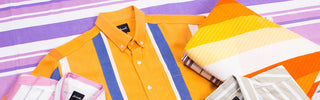
Production
The balance between clothes and nature.

Who produces Pleasant?
Pleasant selects suppliers based on both skills and personality.
Production is cheaper abroad, and this has an impact on how we can price ourselves.
To make upcycling mainstream, our price level must land at a widely accessible level.
Production countries

Bulgaria
We are very grateful to all our suppliers who help us make our ideas a reality. In Bulgaria we work with competent and flexible factories. Upcycling and sewing clothes from used textiles is also a completely different way of thinking about production. Our partners in Bulgaria help us think of solutions, even if it requires doing things a little differently.

Philippines
It's hard to talk about Pleasant without getting into the Philippines. We've been working with the same two sewing rooms in the Philippines since 2008. Our annual travels have brought us closer to an inspiring culture, mentality and wild waves.
However, due to distance reasons, we are minimizing our production in the Philippines.
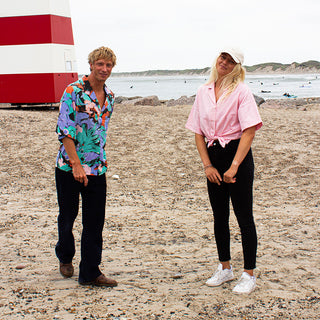
To achieve change, you have to try something new.
In our production, we follow that mindset and the following goals.
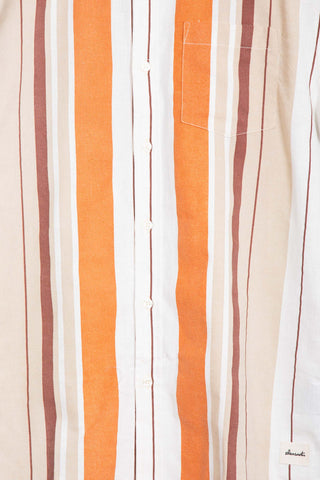
1st goal
Clothes without new textiles
The clothing industry's greatest environmental impact lies in material production. The greatest environmental savings can therefore be achieved by avoiding new textiles.
The key is to make as much clothing as possible with as little new textile as possible.
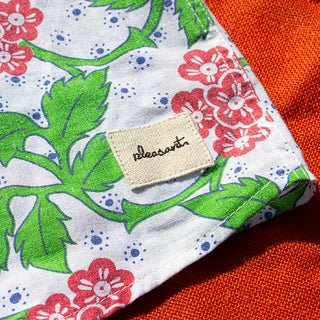
We haven't bought new textiles since 2021.
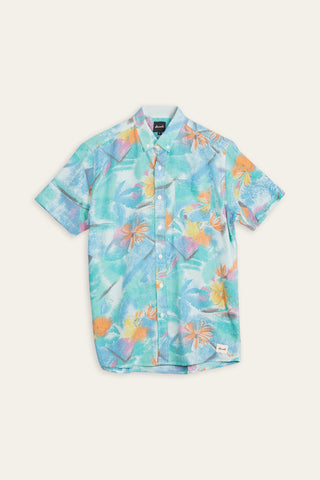
We upcycle and make new clothes from used textiles.
Tablecloth caps
Duvet cover shirts
Jackets made of curtains
How does upcycling make a difference in the fashion world?

Big environmental savings
A single shirt made of new fabric requires thousands of liters of water.
The textile industry uses over 2,500 chemicals, 1,000 of which are harmful.
Satisfying Europe's textile needs requires 4 times the area of Denmark.

Distribution of CO2 for a shirt made of new cotton
vs.
Pleasant upcycled shirt*
* In addition to new textile in sewing thread and labels.
** Upcycled shirt made of Danish material produced in the Philippines, and shipped by container ship round trip.

2nd goal
Clothes without air transport

When you sell timeless, production is less of a race against time.
Already here, air transport becomes much less attractive.
When we ship used textiles from Denmark to abroad, and ship new clothes back, it is done by ship, train or truck. Shipping by plane emits over 70 times as much CO2 as shipping by container ship*.
As a general rule, we never use air transport in our production. This only happens in cases of absolute emergency.

3rd goal
Clothes without plastic and cardboard
It's good to recycle plastic and cardboard. But it's even better not to use it at all.
Instead of packing our clothes in plastic bags, we ship both clothes and textiles in reusable cloth bags.
We also use reusable plastic boxes rather than cardboard boxes. Hang tags are something we only add to clothing for retailers who want them.
4th goal
Waste-free clothing
The benefits of selling clothes timelessly
The most obvious countermeasure against clothing waste is a crackdown on limited-time collections.

Products from leftovers
Surplus textiles after production are difficult to avoid. We collect our own surplus textiles and produce smaller products.
For example, caps, children's shirts and scrunchies.

5th goal